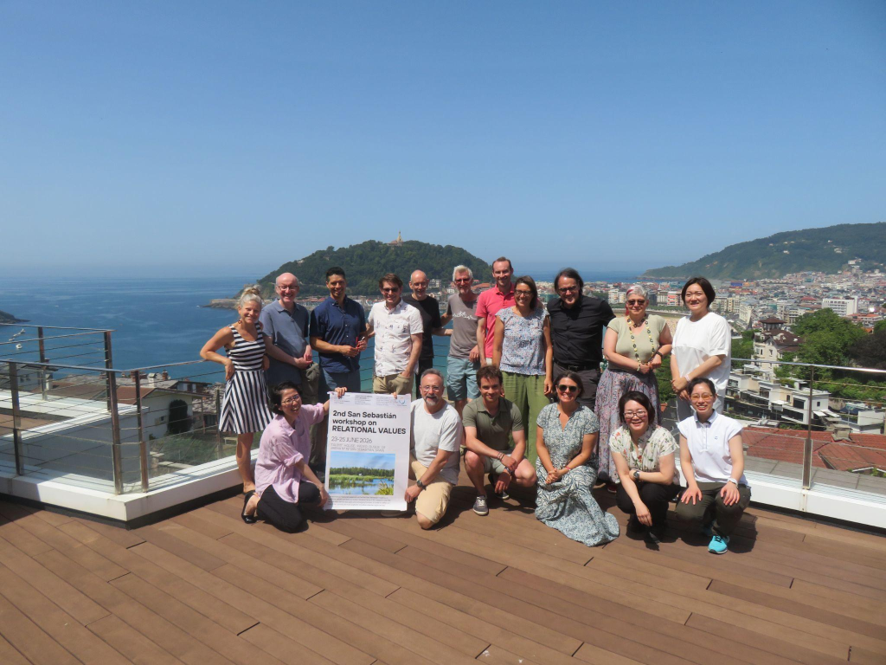
Second San Sebastián Workshop Advances Relational Values in Biodiversity Governance
ZHENG, Hao
From 23 to 25 June, Dr. Hiroe Ishihara (The University of Tokyo) and Prof. Unai Pascual (Basque Centre for Climate Change, BC3, and Ikerbasque) co-hosted the Second San Sebastián Workshop on Relational Values in San Sebastián, Spain.
Relational values—the values that emerge from relationships among people and between people and nature—have become an influential concept in biodiversity governance, including the work of the Intergovernmental Science-Policy Platform on Biodiversity and Ecosystem Services (IPBES). Around a decade ago, the first San Sebastián workshop played an important role in shaping and advancing this concept.
Bringing together 17 leading international scholars in the field of relational values, the workshop reviewed a decade of research, identified emerging challenges, and discussed future directions for advancing the role of relational values in biodiversity governance and justice-oriented sustainability. Discussions also considered how the concept can move beyond theoretical debates to inform policy and practice in addressing contemporary biodiversity challenges.
The workshop was held as part of a collaborative research project under the partnership agreement between Kubota Corporation and the University of Tokyo, with additional support from the Sumitomo Foundation Environmental Research Grant Program and the Environmental Research and Technology Development Fund (S-21).